
I.What is PTC heating, and what is its function?
PTC stands for Positive Temperature Coefficient; its core component is a PTC ceramic element—a type of semiconductor ceramic. It functions as a positive temperature coefficient thermistor, meaning its electrical resistance increases as the temperature rises. When power is first applied, the ceramic element is cool and its resistance is very low, allowing for high current flow and rapid heating. Once the temperature reaches the Curie temperature (typically 80–120°C), the resistance spikes sharply. This increase in resistance causes the current to drop significantly and the heating power to decrease automatically, preventing the temperature from rising further. When integrated into a battery thermal management system, it serves as the core component for preheating the batteries of large electric commercial vehicles in cold environments.
II. Advantages and Disadvantages of PTC Heating
PTC heaters feature excellent self-limiting temperature characteristics; power output automatically decreases once the set temperature is reached, eliminating the risk of dry-heating or overheating and ensuring superior safety. They offer rapid warm-up from a cold state, are free from the risks of high-temperature oxidation or burnout associated with metal resistance wires, and possess strong vibration resistance—making them ideal for the prolonged, high-intensity operation of commercial vehicles like electric buses and heavy-duty trucks. When paired with a liquid cooling circuit, they can uniformly heat the battery pack, effectively minimizing temperature differentials between cells and ensuring thermal consistency across the battery assembly, even providing stable preheating for power batteries in extremely cold environments.
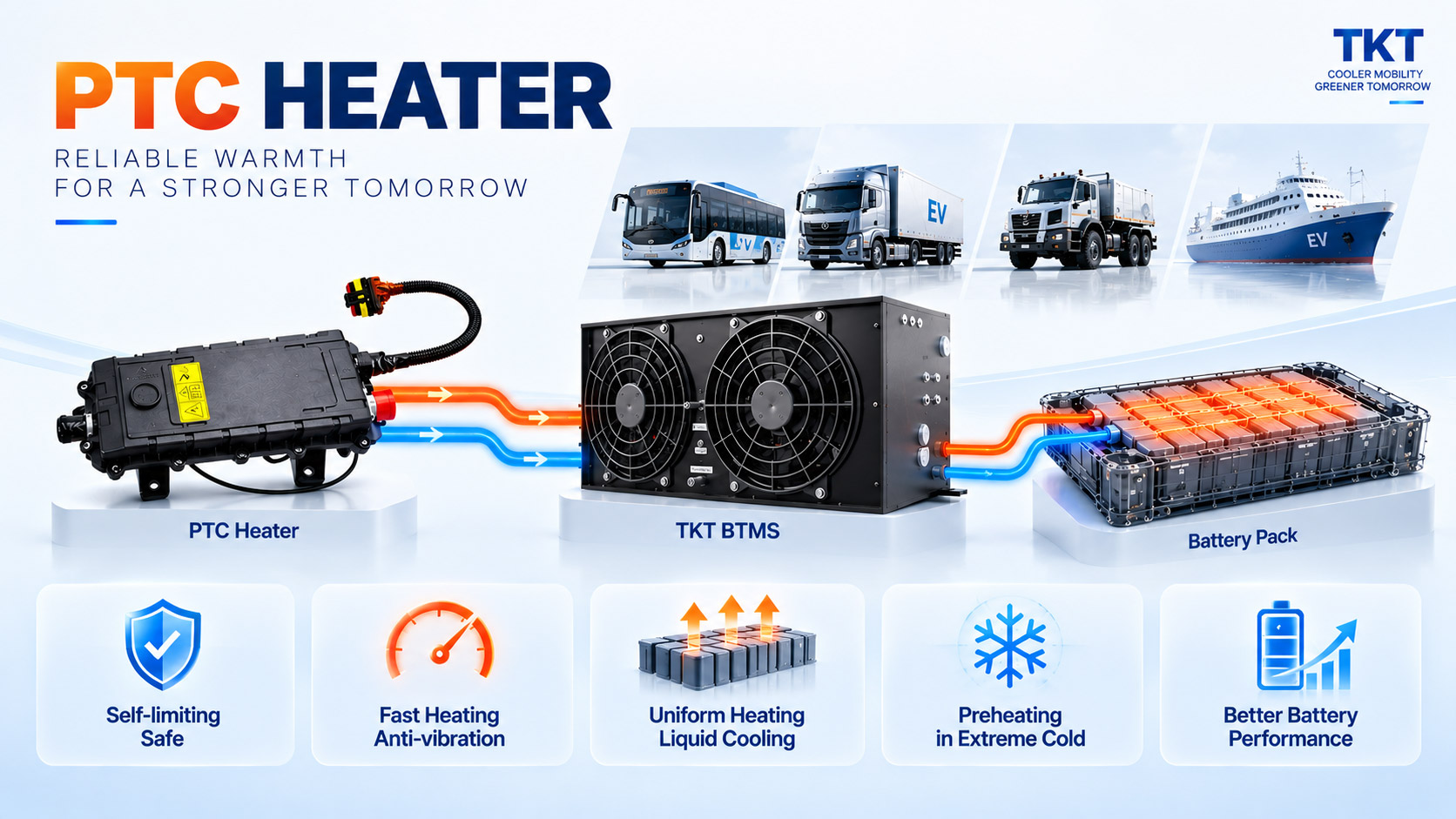
Despite their excellent overall performance, PTC heaters have inherent limitations. They consume energy from the power battery during operation, leading to reduced driving range in winter; furthermore, as the temperature rises, heating power automatically drops, preventing sustained, constant high-power output. Compared to standard resistance heaters, PTC assemblies entail higher procurement costs and are bulkier and heavier. As high-voltage components, they require rigorous insulation, sealing, and waterproofing. Additionally, the Curie temperature is determined by the ceramic substrate, making it difficult to flexibly adjust the constant-temperature operating range. TKT’s integrated battery thermal management system effectively addresses these shortcomings. By leveraging intelligent BMS coordination and an optimized liquid cooling circuit design, the system intelligently manages PTC heating timing and power output, reducing winter energy consumption while maintaining uniform cell temperatures.
III. How PTC Heating Technology Operates Within Battery Thermal Management
PTC heating technology serves as the core heat source for battery thermal management systems in electric commercial vehicles, utilizing the unique physical property of ceramic thermistors to self-limit temperature based on the Curie point. Upon connection to the high-voltage circuit, the PTC core exhibits low resistance in a cold state, allowing for rapid, high-power heat output to warm the coolant in the circuit. When the temperature reaches the material's Curie threshold, resistance rises sharply, automatically reducing heat output; this provides hardware-level overheat protection and eliminates safety hazards—such as dry-heating and localized overheating—common in traditional resistance heaters, making the technology well-suited for the vibration and rough road conditions experienced by buses and heavy-duty trucks.
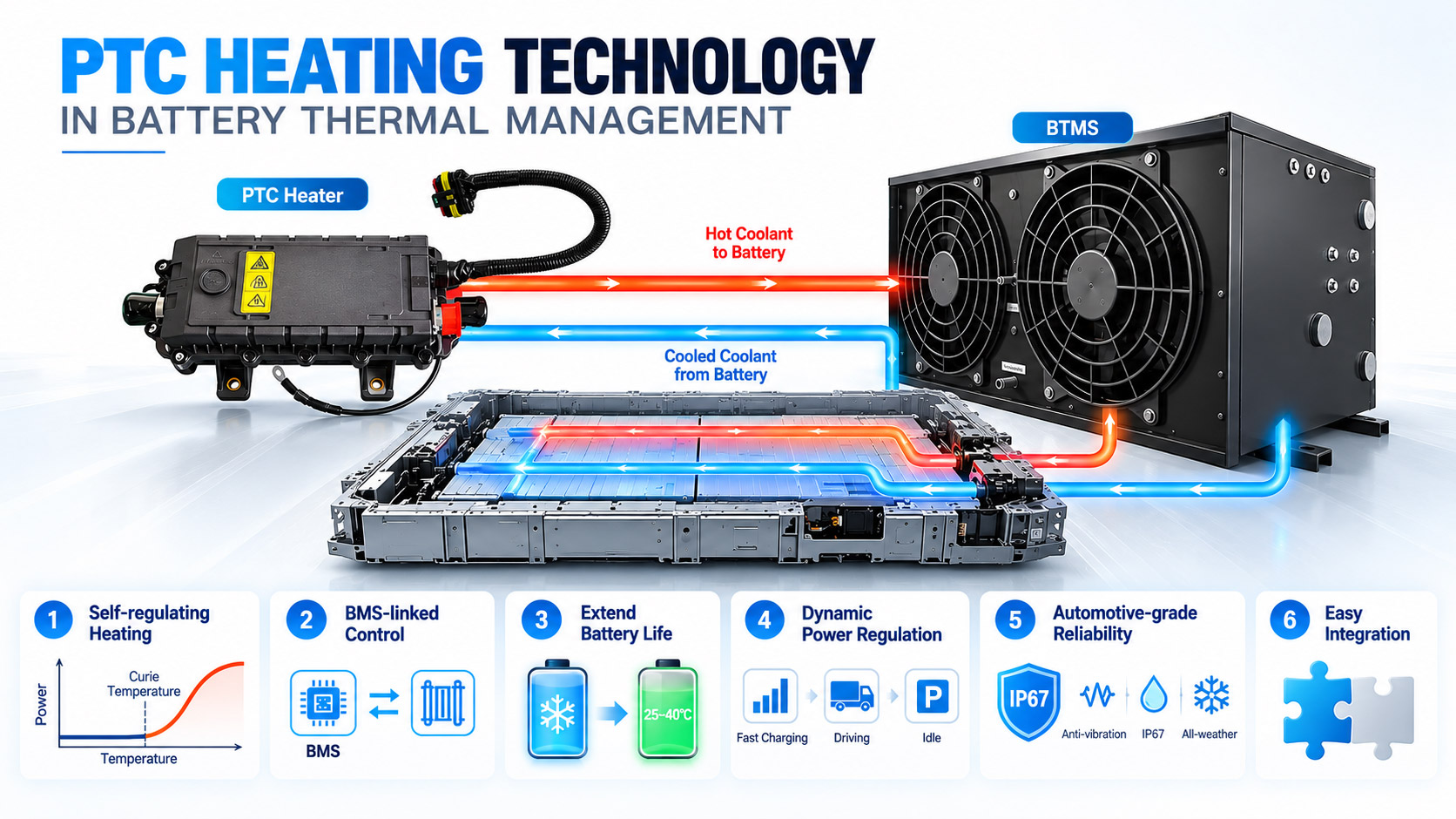
Regarding battery thermal management logic, the PTC heater operates in coordination with the liquid cooling circuit and the Battery Management System (BMS). During the preheating phase in low-temperature environments, constant-temperature coolant flows through the battery's liquid cooling plate, facilitating uniform heat exchange across the cells. This prevents localized hotspots, minimizes temperature differentials between cells, and ensures cell consistency. From an electrochemical perspective, raising the battery temperature to the optimal operating range of 25–40°C enhances lithium-ion activity, inhibits lithium plating (a common issue during low-temperature charging), reduces irreversible capacity loss, and extends the cycle life of the power battery.
At the system integration level, the high-voltage liquid-cooled PTC heater precisely receives signals from the BMS and dynamically adjusts heating power to meet thermal demands across various operating conditions, such as fast charging, idling, and driving. This heating solution offers rapid response times, quickly raising the battery pack's temperature in cold environments to boost discharge power and significantly reduce charging times. The unit features high vibration resistance and an IP67 protection rating, enabling it to withstand the harsh operating conditions typical of commercial vehicles—including heavy loads, prolonged continuous operation, and exposure to dust, rain, and snow. Furthermore, it shares the existing piping of the liquid cooling system, thereby reducing BTMS integration complexity and vehicle packaging costs, while providing a reliable heat source for stable, all-weather operation in electric buses and heavy-duty trucks.
IV. The Importance of PTC Heating for Electric Commercial Vehicles
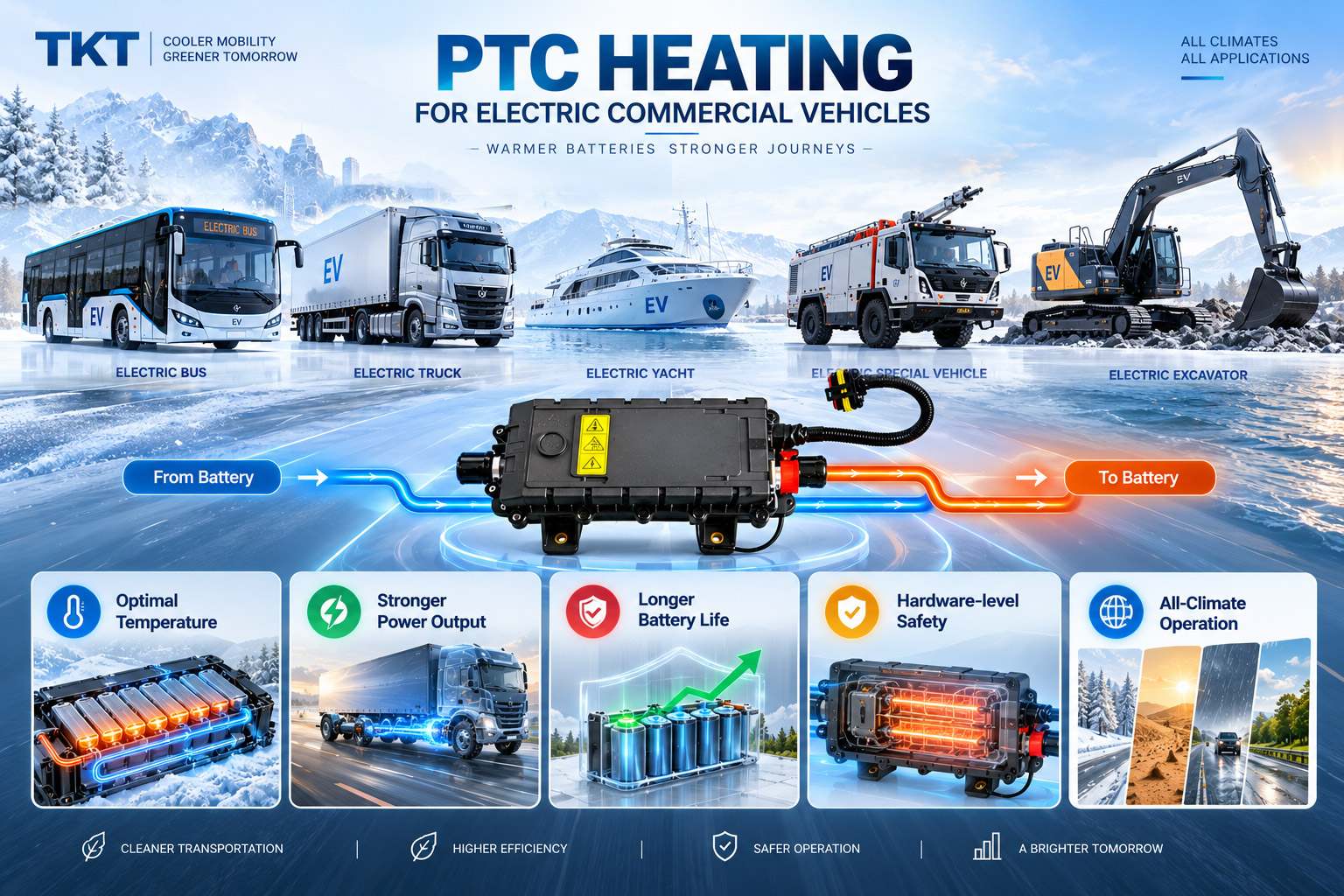
The electrochemical properties of power batteries are highly temperature-sensitive. In low-temperature environments, lithium-ion activity declines, directly leading to reduced usable capacity and insufficient discharge power. Fast charging under these conditions makes the battery highly susceptible to lithium plating, which causes irreversible cell damage and shortens the battery's overall lifespan. Leveraging the self-regulating temperature characteristics of ceramic materials and working in tandem with the vehicle's liquid cooling circuit and BMS, the PTC heater rapidly warms the coolant in low-temperature conditions. Heat is then evenly transferred to the entire battery pack via the liquid cooling plate, maintaining the cells within the optimal operating range of 25–40°C. On one hand, uniform preheating strictly controls temperature differences between battery cells, ensuring pack-level consistency and boosting discharge power to maintain stable performance during high-load scenarios such as vehicle startup and hill climbing. On the other hand, it effectively mitigates lithium plating during charging, significantly improving charging efficiency in low-temperature environments and reducing downtime for fleet recharging. Additionally, the PTC system features built-in hardware-level overheat protection, preventing safety risks like dry heating or localized overheating—critical for the demanding operating conditions faced by commercial vehicles, including vibrations, dust exposure, and continuous all-weather operation. Unlike passenger cars, electric commercial vehicles carry heavy loads and operate for extended periods, often requiring non-stop service; PTC heating ensures stable operation in cold or even extreme-cold regions, reduces battery maintenance and replacement costs, and lowers operational risks, making it a key technology for the all-weather commercial deployment of heavy-duty electric commercial vehicles.
V. Superior Performance of TKT Battery Thermal Management Systems
Addressing industry challenges such as heavy loads, long operating hours, and complex working conditions associated with heavy-duty commercial vehicles, TKT’s team of 135 professional engineers has developed a Battery Thermal Management System (BTMS) with a power range of 3–10 kW, offering OEM/ODM customization services. Since 2012, TKT’s battery thermal management solutions have served over 150 vehicle manufacturers worldwide—including renowned companies like BYD and TATA—earning widespread acclaim. Leveraging integrated liquid cooling and PTC heating technology, the product provides high-performance, all-in-one thermal control solutions for commercial electric vehicles globally.
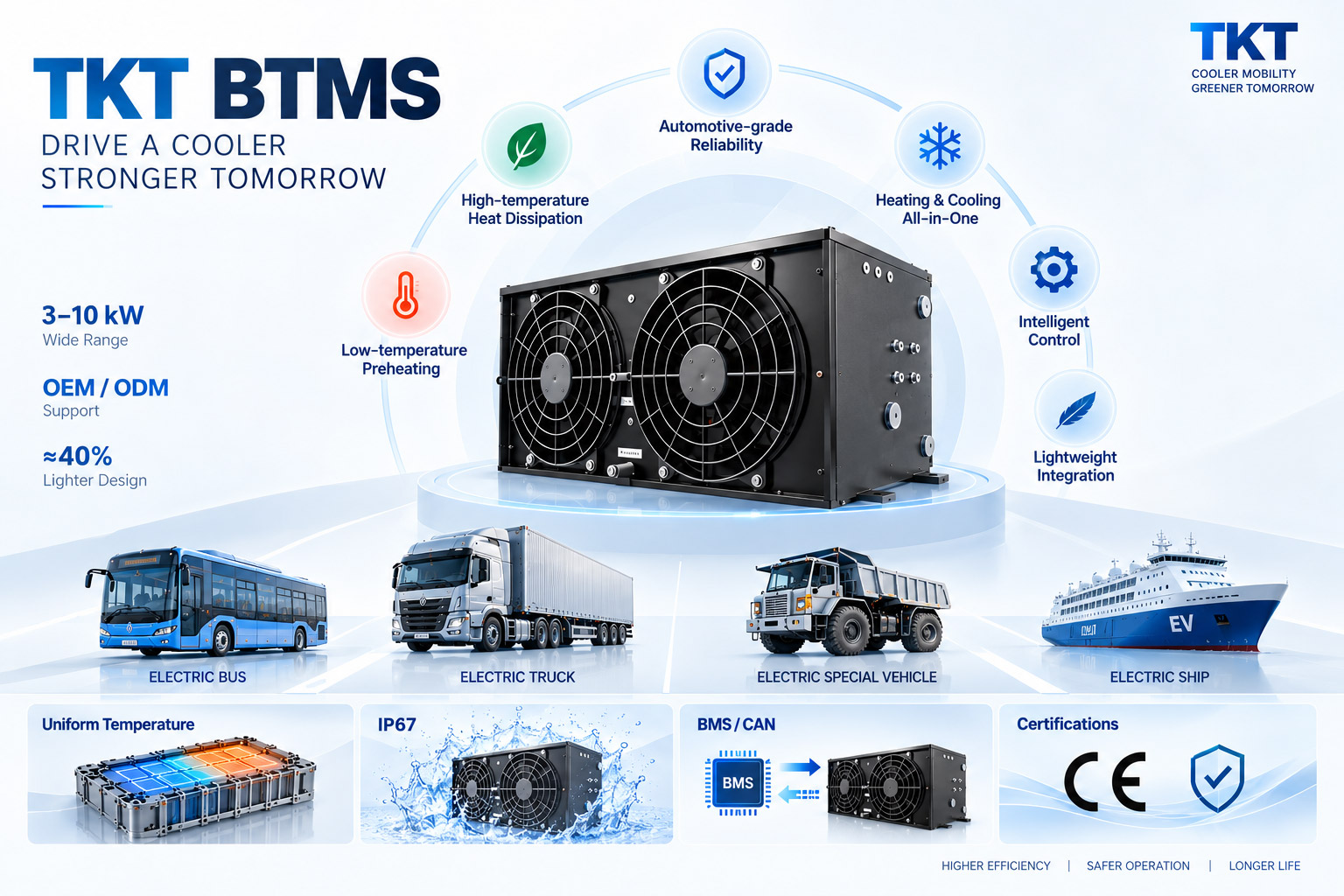
The system utilizes a liquid cooling architecture—employing an ethylene glycol mixture for cooling combined with PTC heating—to deliver both heat dissipation and low-temperature preheating capabilities. It precisely controls the temperature difference between battery cells to within ±0.5°C, offering superior heat exchange efficiency compared to air-cooled solutions. During high-temperature driving and high-power charging, the efficient liquid cooling system rapidly dissipates heat generated by the battery, mitigating the risk of overheating. In low-temperature environments, the PTC heater provides rapid, uniform preheating of the battery pack; this addresses issues such as reduced power output and slow charging, effectively inhibits lithium plating and cell aging, and extends the battery's cycle life.
In terms of hardware, the product features a proprietary structural design that achieves high integration and lightweighting—reducing the unit's weight by approximately 40% compared to similar products and effectively lowering the load on the vehicle. Its electrical components meet the IP67 protection standard, ensuring resilience against harsh operating conditions such as rain, snow, vibration, and dust. The system interfaces with the vehicle's BMS via the CAN bus to intelligently regulate heating and cooling power, preventing battery damage caused by improper operation. Additionally, it has obtained CE certification and undergone vehicle-level reliability testing, ensuring stable performance under complex operating conditions.
Conclusion
The PTC heater is a critical component of thermal management systems for modern electric commercial vehicles, working in synergy with technologies such as battery coolers, liquid-cooled lithium-ion batteries, and liquid cooling solutions. Cold weather typically weakens battery power, slows charging, and accelerates aging; however, the PTC heater can preheat the battery or the pack based on ambient temperatures, maintaining the battery within its optimal operating range. This improves charging performance, minimizes temperature differentials between cells, and extends the battery's service life. For vehicle manufacturers, fleet operators, and battery system integrators, a comprehensive thermal management system capable of both heating and cooling is essential. With this temperature control system, the power battery maintains stable performance in both extreme cold and high heat, ensuring the continuous and safe operation of electric commercial vehicles.



.jpg)
.jpg)